

Table of Contents
Finding reliable information about Foxtpax software is more difficult than it may initially appear. Several recently published pages describe Foxtpax as a business management platform, while other sources present it as a technology intelligence service, a Python development library, or a decentralized data-security solution. These descriptions do not always agree with one another.
The official Foxtpax website identifies foxtpax.com primarily as an independent publication and information resource. However, other pages on the same website discuss products and technologies carrying the Foxtpax name. This creates uncertainty for readers who simply want to understand whether Foxtpax is a downloadable application, an enterprise platform, a software development kit, or an informational technology brand.
This guide brings together the available information about Foxtpax software without repeating promotional claims as confirmed facts. It explains what Foxtpax appears to represent, the functions commonly associated with it, its potential benefits, its possible users, and the questions that should be answered before anyone downloads, purchases, or integrates the platform.
The goal is not to promote or dismiss the product. Instead, the purpose is to help readers evaluate Foxtpax carefully, understand the uncertainty surrounding it, and make a better-informed decision.
What Is Foxtpax Software?
The clearest answer is that Foxtpax currently appears to be a developing technology brand with several different software-related descriptions attached to its name.
According to the official website, Foxtpax is an independent publication and information resource covering technology concepts, innovation, smart devices, network architecture, and system optimization. Its homepage is structured mainly like a technology publication, containing educational articles about the Internet of Things, quantum computing, wearable devices, smart-device security, and emerging infrastructure.
At the same time, pages published under the same domain describe Foxtpax as an operational software system. One page presents it as a technology intelligence platform that collects, evaluates, and simplifies technical developments. Another describes it as a secure data-storage solution using encryption and distributed infrastructure. A separate page presents Foxtpax as a Python SDK designed for monitoring, automation, and system optimization.
This means that anyone searching for information about Foxtpax software should recognize an important distinction: there is a difference between what has been described in articles and what can be independently verified through product documentation, public repositories, customer references, or established software directories.
Foxtpax may be an early-stage or evolving project, but its exact commercial and technical status is not presented consistently across the available sources.
Why Is There Confusion About Foxtpax?
The main source of confusion is that the Foxtpax name is associated with several different categories of technology.
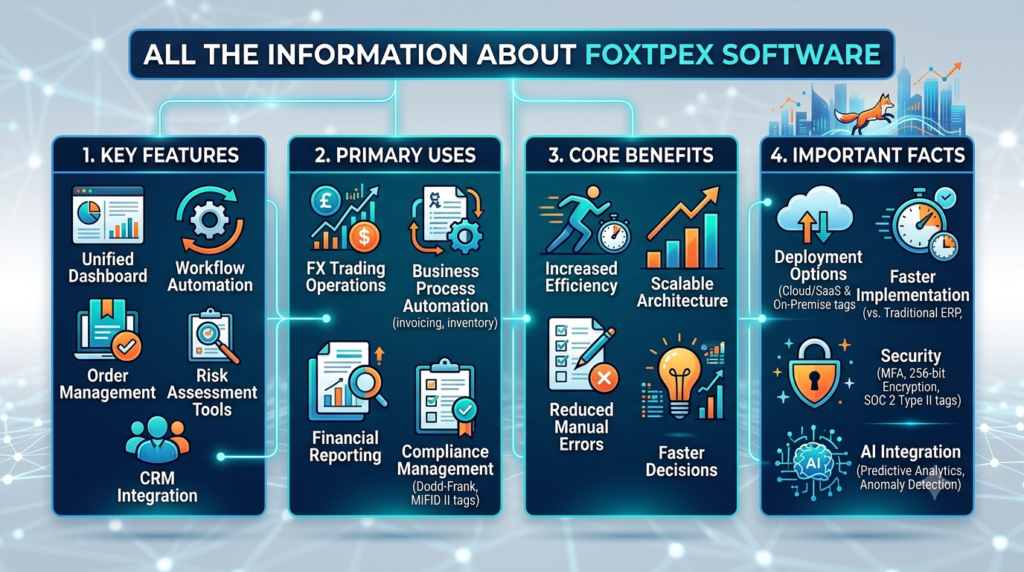
Some articles describe it as an all-in-one business operations platform. Under that description, the software supposedly combines workflow automation, customer management, reporting, finance, collaboration, and business data in one environment. Several independent websites published similar summaries during 2025 and 2026.
However, the official domain does not consistently present Foxtpax as that type of business management suite. Its homepage focuses more heavily on technology education and editorial content. Other internal pages discuss intelligence gathering, network monitoring, encrypted storage, software optimization, and Python development.
Reliable information about Foxtpax software must therefore separate three things: the Foxtpax website, the software concepts discussed on that website, and the business-platform descriptions published by third-party blogs.
Those three areas may eventually prove to be connected, but the publicly available material does not yet explain the relationship clearly enough to treat every description as part of one confirmed product.
What Can Be Verified About Foxtpax?
The official website provides identifiable brand information, contact details, editorial categories, author profiles, terms of use, and a stated organizational description. These details confirm that foxtpax.com operates as a technology-focused website and publication.
The official brand page names the organization as foxtpax.com, describes it as an independent publication and information resource, and identifies Zelric Vosswyn as its founder. The website also publishes articles related to network architecture, technology optimization, smart devices, innovation, and software-related concepts.
What remains less clear is whether a fully released commercial software product is currently available under the Foxtpax name. The examined pages make references to software functionality, demos, SDK-style integration, encryption tools, decentralized storage, and even a free personal tier. However, those claims are not supported within the reviewed material by a consistently presented download portal, public technical documentation, verified package listing, transparent pricing page, or independently confirmed customer case study.
The following table summarizes the difference between established and uncertain information about Foxtpax software.
| Area | What the Available Sources Indicate | Verification Status |
| Official website | Foxtpax operates a technology publication and information resource | Confirmed by its official brand page |
| Editorial coverage | The website publishes content about IoT, networks, smart devices, innovation, and optimization | Visible on the official website |
| Technology intelligence | Foxtpax is described as filtering and interpreting emerging technology information | Claimed on official-domain articles |
| Secure storage | A Foxtpax page describes client-side encryption and distributed file storage | Claimed, but independent validation is limited |
| Python SDK | A Foxtpax page describes a Python library for monitoring and automation | Claimed, but public package documentation is unclear |
| Business management suite | Third-party articles describe CRM, workflow, finance, and reporting modules | Repeated by blogs, but not clearly established by the official homepage |
| Pricing | Various pages mention plans or scalable use | No consistently verified public pricing structure |
| Customer adoption | Some articles discuss possible business applications | Independently verified case studies are not clearly available |
Commonly Described Features of Foxtpax Software
The features associated with Foxtpax depend heavily on which source is being read. Therefore, they should be understood as described capabilities rather than guaranteed product specifications.
One group of pages presents Foxtpax as a technology intelligence system. Under this interpretation, the platform collects information from technical sources, identifies useful developments, removes repetitive material, and delivers organized insights to developers, product managers, IT architects, and technology leaders.
A second description focuses on secure data storage. According to that version, Foxtpax uses client-side encryption, divides files into encrypted fragments, and distributes those fragments across multiple network locations. The stated objective is to reduce dependence on a single centralized storage provider and give users greater control over their data.
A third source of information about Foxtpax software describes a Python-based SDK. It is presented as a development library that can support system monitoring, network analysis, device management, automation, error handling, and performance optimization directly within Python projects.
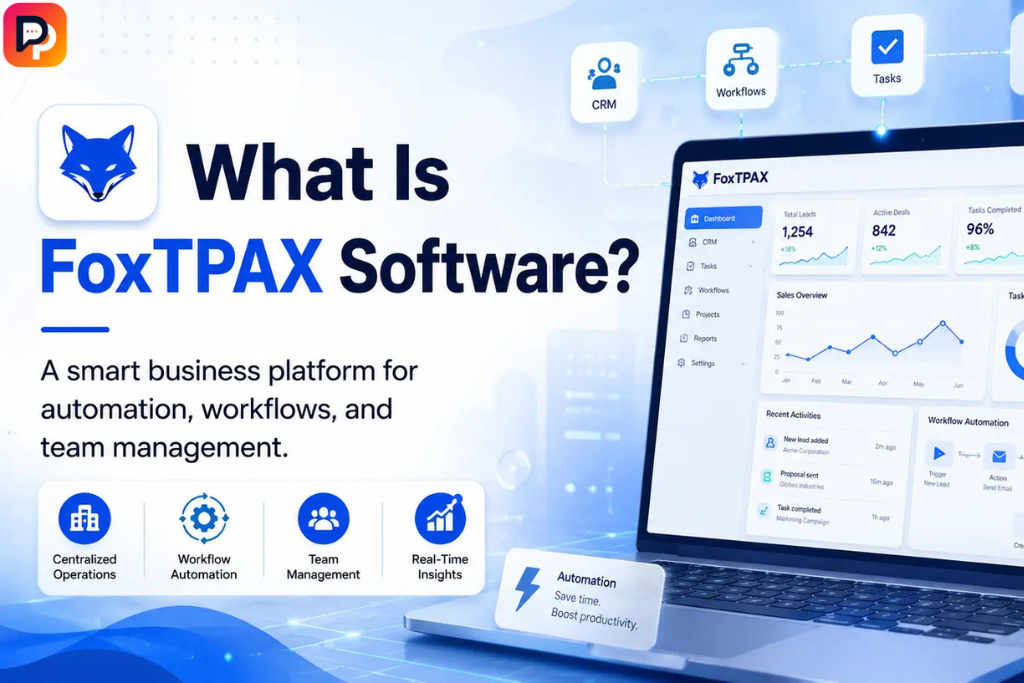
Third-party websites add another category by describing Foxtpax as an integrated business platform. These pages associate it with customer relationship management, task automation, financial reporting, team collaboration, inventory control, analytics, and centralized operational data.
The problem is not that these features are technically incompatible. A large technology platform could theoretically include all of them. The problem is that the available material does not provide a single authoritative product specification connecting these capabilities.
How Foxtpax Software Is Supposed to Work
Under the technology-intelligence description, Foxtpax reportedly gathers information from technical publications, research, patents, network data, and industry sources. That information is then cleaned, categorized, analyzed, and converted into practical recommendations.
The system is described as going beyond a basic news aggregator. Instead of merely displaying headlines, it is supposed to identify the relevance of a development and show how that development could affect a user’s network, devices, software stack, or technology roadmap.
Under the data-security description, the working process is different. Files are reportedly encrypted on the user’s device before transmission. They are then divided into smaller encrypted pieces and distributed across multiple storage nodes. The software allegedly maintains a map that allows those pieces to be reconstructed when an authorized user requests the file.
The Python version of information about Foxtpax software presents it as a programmable toolkit rather than a traditional desktop application. Developers would theoretically install or connect the library to an existing Python environment and use its functions for monitoring, automation, resource management, and optimization.
These descriptions represent three significantly different architectures. Until official technical documentation defines the relationship between them, readers should not assume they are all available within one installable product.
Potential Business Uses of Foxtpax
If the business-management descriptions are accurate, Foxtpax could be useful for organizations that currently operate through disconnected applications and spreadsheets.
A company might use the platform to keep customer records, internal tasks, operational reports, invoices, financial information, and employee collaboration in one environment. Centralization can reduce repeated data entry and make it easier for decision-makers to see how different parts of the organization are performing.
The workflow-automation concept is particularly relevant to businesses with repetitive administrative processes. A connected system could theoretically create tasks when a sale is completed, update inventory after an order, notify the finance team when an invoice becomes overdue, or generate reports based on live operational data.
However, this information about Foxtpax software should not be treated as confirmation that every described business module is currently available. Organizations should request a live demonstration using their own workflow, not a generic presentation designed around ideal conditions.
A serious evaluation should also determine whether the platform can import existing records accurately, preserve historical data, support role-based permissions, integrate with current accounting tools, and export information in a usable format if the organization later decides to leave.
Potential Uses for Developers and IT Teams
The developer-focused version of Foxtpax could appeal to teams that manage complex systems, connected devices, network infrastructure, or data-intensive Python applications.
Its described monitoring functions could help teams observe system performance, identify resource problems, detect network changes, and automate routine maintenance. Device-management features could also be useful in environments containing many connected sensors, endpoints, or Internet of Things devices.
The Python SDK description suggests that Foxtpax is intended to work inside existing development workflows. This could be more flexible than forcing engineers to move between multiple dashboards, especially when monitoring logic needs to trigger automated actions inside an application.
Nevertheless, developers seeking information about Foxtpax software should look for conventional technical evidence before using it in production. That evidence should include installation instructions, supported Python versions, dependency lists, API references, code examples, version history, licensing terms, security disclosures, issue tracking, and maintenance activity.
Without those materials, a development team cannot reliably estimate compatibility, performance, long-term support, or the risk of building important infrastructure around the software.
Possible Benefits of Foxtpax Software
The strongest potential benefit is consolidation. Whether Foxtpax is viewed as an intelligence platform, development toolkit, security system, or business operations suite, its central promise is to reduce fragmentation.
Technology teams often lose time moving between monitoring dashboards, documentation tools, news sources, scripts, and device-management systems. Businesses face a similar problem when customer records, projects, finances, inventory, and reports are maintained separately.
A properly implemented unified platform can reduce duplicate work, improve visibility, and make information easier to act upon. It can also create more consistent processes because employees are working from the same records rather than maintaining different versions of the truth.
Another possible advantage highlighted in available information about Foxtpax software is adaptability. Third-party descriptions portray the system as modular, meaning an organization could theoretically begin with a limited set of functions and add more capabilities as its needs grow.
The security-oriented descriptions add potential benefits such as client-side encryption, distributed data storage, and reduced dependence on a central provider. These are meaningful architectural ideas, although their real value depends on implementation quality, independent auditing, key-management design, recovery procedures, and actual performance.
Limitations and Risks to Consider
The largest limitation is the lack of a single, consistent product identity. Readers should be able to determine quickly whether a product is a publication, cloud service, Python package, desktop program, security platform, or enterprise suite. Foxtpax is currently described across several of these categories.
This inconsistency makes it difficult to compare the product with established alternatives. It also raises practical questions about which features are active, which remain conceptual, which require custom development, and which belong to separate projects.
Another concern is the limited amount of independently verifiable evidence. Many articles repeat similar features, but repeated claims are not equivalent to technical validation. A reliable evaluation requires direct product documentation, working demonstrations, contractual details, security policies, and credible customer experience.
The following table highlights the major questions that arise from the currently available information about Foxtpax software.
| Evaluation Area | Main Question | Why It Matters |
| Product identity | What exactly is being purchased or installed? | Prevents confusion between editorial content and software services |
| Availability | Is there a production-ready version? | Determines whether the platform can support real operations |
| Documentation | Are complete technical and user guides available? | Reduces implementation and training risk |
| Security | Has the platform undergone independent security testing? | Marketing claims alone cannot prove data protection |
| Integration | Which verified APIs and applications are supported? | Determines compatibility with existing systems |
| Pricing | What are the setup, subscription, support, and migration costs? | Prevents unexpected long-term expenses |
| Data ownership | Can customers export all their records in standard formats? | Reduces vendor lock-in |
| Support | What response times and service guarantees are provided? | Important when critical systems experience problems |
| Customer proof | Are there verifiable organizations using the platform? | Helps confirm reliability outside controlled demonstrations |
Security and Privacy Considerations
Security claims deserve careful examination because sophisticated terminology can create confidence without proving that a system is secure.
The Foxtpax security page describes client-side encryption, separate encryption of file fragments, distributed storage, and a design in which the service provider supposedly does not control the user’s decryption keys. These are privacy-supporting concepts when implemented correctly.
However, secure architecture depends on details. Buyers need to know which encryption algorithms are used, how keys are generated, where recovery information is stored, how authentication works, how compromised devices are handled, and whether the software has been tested by an independent security company.
Anyone reviewing information about Foxtpax software should also ask whether the provider publishes a detailed privacy policy, data-processing agreement, breach-response procedure, retention schedule, backup policy, and list of infrastructure partners.
Organizations handling financial, healthcare, educational, employee, or customer information may have legal obligations that cannot be satisfied by general promises of encryption. They should obtain written confirmation of relevant compliance controls and have the agreement reviewed by qualified technical and legal professionals.
Integration and Deployment Questions
A modern platform rarely operates alone. Even an all-in-one system must communicate with email providers, accounting applications, payment services, databases, identity systems, analytics tools, and existing internal software.
Third-party descriptions suggest that Foxtpax may support cloud, private, or on-premises deployment. Other articles refer to APIs, modular architecture, microservices, and Python integration. These descriptions sound flexible, but they need to be confirmed for the specific version being evaluated.
Reliable information about Foxtpax software should identify supported operating systems, browsers, databases, hosting regions, authentication standards, API limits, data formats, and integration requirements.
Buyers should also examine the migration process. Importing customer records or operational data is rarely as simple as uploading a spreadsheet. Fields may not match, records may be duplicated, date formats may differ, and historical relationships may be lost.
A small pilot using copied or non-sensitive data is safer than moving an entire organization immediately. The pilot should reproduce a real process from beginning to end and measure accuracy, speed, usability, reporting quality, and support responsiveness.
Foxtpax Software Pricing and Licensing
A dependable public pricing structure could not be clearly established from the reviewed sources. Some pages refer generally to different plans, scalable modules, demos, or a personal tier, but the exact relationship between those offers and the various Foxtpax descriptions remains uncertain.
That does not necessarily mean the software is unavailable. Enterprise platforms frequently use quotation-based pricing because costs depend on the number of users, modules, integrations, deployment preferences, data volume, and support level.
However, trustworthy information about Foxtpax software should eventually explain what customers are paying for. Pricing discussions should include subscription charges, implementation fees, data migration, customization, storage, API usage, training, premium support, upgrades, and cancellation conditions.
Licensing is equally important for the described Python toolkit. Developers need to know whether it is open source, free for commercial use, restricted to personal projects, or offered under a proprietary enterprise agreement.
Until those details are provided in clear written terms, users should avoid assuming that references to a free version, SDK, download, or enterprise platform apply universally.
How to Evaluate Foxtpax Before Adoption
The best evaluation begins with a precise explanation from the provider. Ask for the official product name, current version, deployment model, supported modules, and intended customer type.
Next, request a demonstration based on a real scenario. A business might ask the provider to import sample customer records, create an automated workflow, produce a financial report, assign permissions, and export the completed data. A development team might request installation, API authentication, monitoring configuration, error handling, and performance measurements.
The available information about Foxtpax software should then be compared with what actually happens during the demonstration. Any feature described online but unavailable in the live system should be explained clearly.
Technical teams should inspect documentation and test integration requirements. Security teams should review encryption, authentication, logging, backup, incident response, and data-recovery controls. Business leaders should calculate the full cost of ownership rather than looking only at the advertised subscription price.
Finally, the organization should obtain a written agreement covering service availability, technical support, data ownership, confidentiality, cancellation, export rights, and responsibility if the platform fails to meet agreed requirements.
My Opinion About Foxtpax Software
In my opinion, Foxtpax is an interesting name surrounded by several potentially useful technology concepts, but the current public explanation needs much greater clarity.
The ideas associated with it are relevant. Businesses do need better workflow integration. Developers do need simpler monitoring and automation. Users are increasingly interested in private storage and stronger control over their data. Technology professionals also benefit from intelligence services that filter noise and explain why a development matters.
The weakness is not necessarily the underlying concept. The weakness is that a visitor searching for information about Foxtpax software can leave with several different impressions of what the product actually is.
A serious software provider should make its product identity unmistakable. It should show one clear feature list, supported platforms, current version, documentation, screenshots, security details, pricing approach, and customer support process. If Foxtpax publishes those materials and demonstrates that its claimed features work in a real environment, it could become easier to evaluate fairly.
For now, I would describe Foxtpax as a technology brand or developing software concept that requires direct verification before business or production use. I would not reject it automatically, but I would not place sensitive data or essential operations into it based only on online articles.
Conclusion
Accurate information about Foxtpax software requires a cautious and balanced approach. The official Foxtpax website clearly exists as a technology publication and information resource. It publishes content about smart devices, network architecture, innovation, optimization, security, Python development, and emerging technology.
Beyond that established identity, Foxtpax has been described in several different ways. Official-domain articles present it as a technology intelligence service, decentralized security platform, and Python SDK. Third-party articles frequently describe it as an all-in-one business management system with automation, CRM, finance, collaboration, and reporting capabilities.
These ideas could theoretically belong to one broad technology ecosystem, but the publicly available documentation does not yet connect them with enough consistency.
Readers should therefore verify the exact product, available version, technical documentation, pricing, security controls, integrations, licensing, and support arrangements directly with the provider. A controlled demonstration and limited pilot are more valuable than relying on broad promotional descriptions.
Foxtpax may offer useful ideas and may continue to develop into a more clearly defined platform. Until stronger documentation and independent evidence become available, the most responsible conclusion is that its claimed capabilities should be investigated carefully rather than accepted automatically.
Frequently Asked Questions About Foxtpax Software
Is Foxtpax a real software platform?
Foxtpax has an active official website that identifies itself as a technology publication and information resource. The site also contains pages describing software, security, intelligence, and Python-related capabilities. However, a single, consistently documented commercial product could not be fully confirmed from the available public material.
What is Foxtpax software used for?
Different sources associate Foxtpax with technology intelligence, network monitoring, system optimization, encrypted storage, Python automation, and business management. Users should confirm which of these functions are available in the specific Foxtpax product or service they are considering.
Is Foxtpax software safe to use?
The website describes security concepts such as client-side encryption and distributed storage, but claims of this kind should be supported by technical documentation and independent security testing. Users should not upload confidential information until they have verified the provider, software version, privacy terms, encryption design, and recovery process.
Is Foxtpax software free?
Some online descriptions mention free access, personal plans, demonstrations, or scalable packages, but a clear and consistently verified public pricing model is not evident. Prospective users should request written pricing and licensing information directly from the provider.
Should a business adopt Foxtpax software?
A business should consider Foxtpax only after completing proper due diligence. This should include a live demonstration, limited pilot, security review, integration test, data-export test, total-cost calculation, and written service agreement. Essential operations should not be migrated solely on the basis of promotional articles and more.
