

Table of Contents
What Etherions Faston Crypto Actually Is
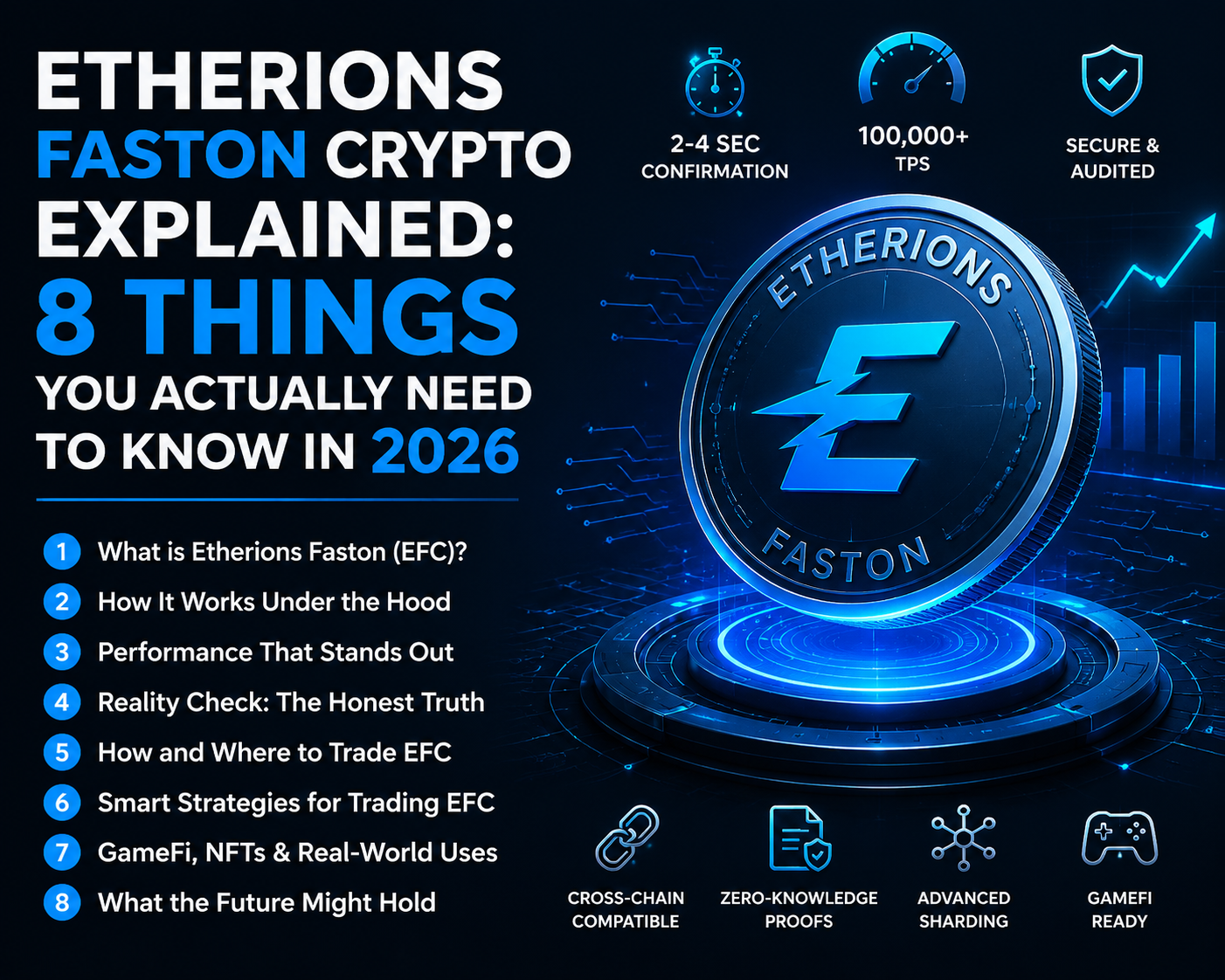
If you spend any time trading crypto, you already know the real enemy isn’t just bad calls — it’s the lag between hitting “confirm” and actually watching the trade go through. That gap is exactly what’s driving interest in Etherions Faston. Etherions Faston Crypto, usually shortened to EFC, is a blockchain built on a reworked version of Ethereum’s architecture, purpose built to shrink that waiting window as much as possible. The “Faston” part of the name isn’t subtle — it’s telling you upfront what the project is selling: fast settlement. Documentation cited by companieshistory.com puts the target north of 100,000 transactions per second.
How Its Speed Stacks Up Against Networks You Already Use
Numbers like that only mean something in context, so here’s how EFC’s claimed performance lines up against the chains most traders are already familiar with:
| Network | Avg. Confirmation Time | Transactions Per Second |
| Etherions Faston (EFC) | 2–4 seconds | 100,000+ |
| Bitcoin | ~10 minutes | 7 |
| Ethereum | ~15 seconds | 30 |
| Solana | ~0.4 seconds | 65,000 |
(Figures sourced from companieshistory.com and iconera.com)
Think about what a 10 minute wait actually costs you on Bitcoin when the market is moving. The price you liked when you hit “send” can be a completely different price by the time it clears. That’s the friction EFC is built to eliminate.
The network went live in late 2024, with a hard cap of 800 million tokens. By mid2025, roughly 480 million of those were already circulating, according to companieshistory.com. It’s also fully compatible with the Ethereum Virtual Machine (EVM) — basically the engine that runs Ethereum’s smart contracts — so developers can bring their existing apps over to EFC without rebuilding everything from the ground up.
So How Does It Actually Achieve That Speed?

Most coverage of EFC just repeats the benchmark numbers and moves on. The more useful question is why it can hit those numbers in the first place, because that’s really what tells you whether the claims hold water.
Every blockchain needs some way for the network to agree on which transactions are legitimate — that’s the consensus mechanism. Bitcoin relies on proof of work, where miners burn through computing power solving puzzles before a block gets confirmed. Ethereum moved to proof of stake, where validators put up tokens as collateral instead, which is quicker and far less energy hungry. EFC takes a hybrid route — project materials call it an adaptive delegated proof of stake system. Validators stake EFC to earn the right to produce blocks, which keeps energy use down compared to pure proof of work chains, while a computational layer on top adds a defense against certain attacks that pure proof of stake setups tend to be more exposed to.
Layered on top of that is sharding and parallel processing. In plain terms, sharding splits the network’s workload across smaller clusters of validators rather than forcing every single node to process every transaction. Picture a busy restaurant running several kitchen stations at once instead of funneling every order through one overworked chef — that’s roughly the idea. Throughput scales out sideways instead of piling up behind one bottleneck.
Here’s what most write-ups skip entirely: settlement speed is only half the story. What matters to actual traders is how the network holds up under real load, not how it performs in a controlled test. EFC also connects to other major blockchains through cross chain bridges, so users aren’t stuck in an isolated ecosystem. On the security side, it leans on zero knowledge proofs — a cryptographic trick that lets the network confirm a transaction is valid without revealing the details behind it, something platforms like Coinbase have flagged as an increasingly standard approach to privacy. The project also says it went through several security audits across 2024 and 2025, which is worth noting since plenty of newer blockchain projects skip independent auditing altogether.
The Part Most Articles Conveniently Leave Out
Here’s something you probably won’t see in the typical promotional writeup, and it’s worth being upfront about.
“Etherions Faston Crypto” isn’t a term with one agreed upon definition across the crypto space. As TycoonStory.com pointed out in its 2026 coverage, different sources frame EFC in different ways — some call it a trading ecosystem, others link it to Ethereum based gaming assets, and a few describe it purely as a DeFi speed layer. That inconsistency is a real red flag, not just a technicality. When a project’s own public identity is still being sorted out, that adds a layer of risk on top of ordinary crypto volatility. It’s a pattern that shows up whenever a project tries to blend crypto, DeFi, and traditional finance under one banner — the same “solid tech, unproven track record” tension shows up in our breakdown of Coyyn.com’s business model.
It’s also worth clearing up a common misunderstanding: a big TPS number by itself doesn’t make a network worth anything. A chain that can theoretically process 100,000 transactions per second but has no developer activity, no real liquidity, and no confirmed exchange listings isn’t offering traders much of value. To be clear, the underlying technology here — high throughput, EVM compatible chains running hybrid consensus — is real and genuinely useful. Whether Etherions Faston specifically lives up to every claim in its documentation is a separate question, and one that needs independent checking, not just trust in the project’s own materials.
Before putting any money in, check whether independent security audit reports have actually been published, confirm the contract address on a blockchain explorer like Etherscan, and look for verified listings on regulated exchanges — Coinbase, Binance, Kraken, that tier. CoinGecko and CoinMarketCap are also good first stops since both show on chain contract data and exchange listing status.
Worth mentioning too: “faston trading” gets used as a general trading style, not just as shorthand for this one platform. It refers to prioritizing fast execution, tight entry and exit timing, and decisions based on data rather than gut calls — principles that apply no matter which network you’re trading on.
How People Actually Trade Etherions Faston Assets
Whether you’re brand new to crypto or you’ve been staring at charts for years, it helps to understand how traders approach fast settlement assets like EFC — the ideas carry over to other markets too.
Faston style trading strategies generally fall into three buckets.
Technical analysis comes first — reading price charts to spot patterns before making a move. Traders working with EFC type assets typically watch candlestick patterns (the bars showing open, close, high, and low for a given period), moving averages (which smooth out price data to show trend direction), the RSI or Relative Strength Index (a 0–100 momentum gauge that flags when something’s overbought or oversold), and volume — checking whether a price move is backed by real trading activity or is thin enough to reverse easily. TradingView remains the go to platform for this kind of work.
Risk management comes next, and it’s where most beginners get burned before they even realize what happened. A disciplined trader caps how much of their account they’re willing to risk on any one trade — usually somewhere around one to two percent — and uses stop loss orders to automatically exit a position once it hits a predefined loss level, before a small setback turns into a serious drawdown. This is the same underlying discipline we cover in our Shopnaclo investment risk breakdown — verify the real numbers before committing money, rather than taking marketing claims at face value. It applies just as much to a new crypto asset as it does to an early stage company.
Entry and exit timing rounds it out. Because EFC settles in roughly 2–4 seconds under normal conditions, it’s technically well suited to both scalping (grabbing small price moves several times a day) and swing trading (holding a position for days or weeks to catch a bigger directional move). The network’s DeFi side also supports lending, borrowing, and yield farming — earning rewards for supplying liquidity to trading pools, the same basic idea behind Uniswap on Ethereum.
The Gaming and NFT Side That Sets EFC Apart

There’s one piece of this project that competitors tend to mention in passing without really explaining, and it actually matters for understanding what makes this ecosystem different from a plain trading chain.
EFC builds blockchain gaming directly into its infrastructure. Each “Etherion” in the gaming layer is an NFT — a one of a kind digital asset with its ownership and history recorded on chain. No two Etherions have identical traits, abilities, or rarity tiers. Players can buy, sell, train, breed, and battle them, which is structurally similar to how Axie Infinity built its economy on Ethereum. The difference here is infrastructure: Ethereum ran into serious gas fee spikes and congestion during the NFT boom of 2021–2022, when a flood of small transactions hit the network all at once and fees ballooned. EFC’s design is meant to absorb that kind of high frequency, low value transaction load without triggering the same fee spikes.
Used in practice, that difference is noticeable — transactions that used to mean waiting around and paying unpredictable fees become near instant and predictable instead, which opens up more room for developers designing actual game mechanics.
The native EFC token runs the whole ecosystem: transaction fees, governance voting (where holders vote on changes to the platform), and staking rewards, which project documentation puts at 8–12% annually depending on network participation, per companieshistory.com. Rare Etherion NFTs also carry their own marketplace value separate from the token price, adding a collectibles angle that most standard DeFi tokens don’t have.
Bottom Line
Etherions Faston sits at the intersection of speed focused blockchain infrastructure, DeFi, NFT gaming, and a broader trading philosophy built around fast execution. The technology behind it is credible, and the performance gap it’s targeting between older networks and modern high throughput chains is a real problem worth solving. The honest caveat is that the project itself is still finding its footing. Start by checking EFC’s listing status and on chain data on CoinGecko, then read through any independent audit reports before putting money into this — or any other emerging crypto asset.
Frequently Asked Questions
Is Etherions Faston Crypto a legitimate project or a scam? Based on what’s publicly available, EFC describes real blockchain technology — hybrid consensus, EVM compatibility, completed security audits. That’s all consistent with legitimate infrastructure work. That said, the project is still maturing and hasn’t been independently verified across every claim it makes. Check for independent audit reports, confirmed listings on exchanges like Binance or Coinbase, and a transparent, verifiable contract address on Etherscan before putting any money in.
How fast are EFC transactions compared to Bitcoin? Per documentation cited by companieshistory.com, EFC is targeting 2–4 second settlement and aiming for 100,000+ transactions per second under normal conditions. Bitcoin, by comparison, takes about 10 minutes per confirmation and handles roughly 7 transactions per second. On paper that’s a massive gap in EFC’s favor — though what actually matters is how it performs under real, peak time load, not just in benchmarks.
What does EVM compatibility mean, and why should traders care? EVM is short for Ethereum Virtual Machine — the engine that runs Ethereum’s smart contracts. EFC being EVM compatible means developers can port existing Ethereum apps, wallets, and trading tools over without rewriting them from scratch. For traders, that means familiar tools like MetaMask and existing DeFi protocols should work on EFC without much of a learning curve.
Can you actually trade EFC on major exchanges? Exchange listings are still developing, and that’s a genuine gap traders should factor into their risk assessment. As with any emerging token, check CoinMarketCap and CoinGecko for verified listings, real trading volume, and on chain contract data — and confirm the contract address on Etherscan to make sure you’re buying the real token and not a copycat trading on the name.
What’s the total token supply for EFC? The cap is 800 million tokens. As of mid 2025, about 480 million were in circulation, according to companieshistory.com. The reported breakdown is 60% in public circulation, 20% held for the team and development fund, 15% earmarked for community and ecosystem growth, and 5% in reserve. Allocation matters here because team tokens that vest over time can create selling pressure down the line.
What trading strategies fit a faston style asset best? Scalping fits the platform’s speed well — small price moves, multiple trades a day. Swing trading works for traders who’d rather hold for several days to catch a bigger move. Either way, the discipline matters more than the style: set your stop loss before you enter, cap risk at one to two percent of your account per trade, and know your exit before you commit money. Trading without an exit plan is where most people lose it.
What’s the difference between “Etherions” the game and EFC the token? Etherions are the individual NFT creatures in the gaming ecosystem, each with its own traits, abilities, and rarity recorded on chain. EFC is the token that powers the platform as a whole — fees, governance, staking. You can hold EFC purely as an asset without ever touching the game, and you can trade Etherion NFTs on their own collectible value, separate from what the token itself is worth.
How does EFC handle privacy and security? It uses zero knowledge proofs — a method that confirms a transaction is valid without exposing the actual data behind it, so your activity gets verified without being visible to everyone on the network. Transaction data is encrypted as it moves between nodes. The project also says it completed several independent security audits in 2024 and 2025, though it’s worth checking those audit reports directly rather than taking the claim at face value and more.
